
Enciclopedia della Tecnologia di Rilevamento a Reticolo di Bragg su Fibra - FAQ FBG - FAQ Sensori FBG - FAQ Demodulatori FBG - Analisi dei Problemi Comuni di Applicazione FBG
Wavelength Range of Fiber Bragg Grating Sensors - Fiber Bragg Gratings with Encapsulated C-Band e Customizable Wavelengths
This article introduces the concept of wavelength customization for FBG sensors e under what circumstances the wavelength of the sensors can be customized. It answers the question of 'Can the wavelength of FBG sensors be customized?' e provides the wavelength customization range for OFSCN® Capillary Seamless Steel Tube FBG Sensors.
Va notato che sia per un sensore di temperatura FBG (termometro FBG), un sensore di deformazione FBG (estensimetro FBG) o un sensore di stress FBG (manometro di stress FBG), la personalizzazione della lunghezza d'onda può essere eseguita. Tuttavia, ciò comporta un prezzo più elevato e un ciclo di produzione più lungo.
1. La lunghezza d'onda FBG può essere specificata?
Each OFSCN® Capillary Seamless Steel Tube FBG Sensor has a unique FBG wavelength during production. The wavelength can theoretically be any value between 1525nm and 1565nm, as well as values near the 850nm or 1310nm bands, or Altro values within the range of 400nm to 2200nm (typical example being 1064nm). However, there are certain limitations to defining the wavelength.
Gli FBG scritti utilizzando metodi di fotomaschera ultravioletta hanno le loro lunghezze d'onda limitate dalla fotomaschera. Una volta determinati i parametri della fotomaschera, l'FBG prodotto utilizzando quella fotomaschera avrà una lunghezza d'onda predeterminata.
D'altra parte, gli FBG scritti utilizzando l'incisione punto per punto con laser a femtosecondi possono avere le loro lunghezze d'onda liberamente regolate.
Il valore della lunghezza d'onda può essere utilizzato per produrre tutti i tipi di sensori FBG (sensori di temperatura, stress, deformazione FBG) e valori diversi della lunghezza d'onda non influiscono sui risultati della misurazione (sebbene possano influire sui coefficienti di calibrazione).
 |
|
Figura 1 |
2. I sensori FBG distribuiti necessitano di FBG con lunghezze d'onda multiple
The main reason for customizing specific wavelengths is often due to the wavelength limitations of the FBG demodulator or the network application requirements of the FBG sensors.
Inoltre, nei singoli sensori FBG distribuiti (noti anche come sensori FBG in serie o sensori FBG a matrice), diversi FBG dovrebbero avere lunghezze d'onda diverse e una spaziatura sufficiente tra di loro senza sovrapposizioni. Se vengono posizionati in canali diversi del demodulatore FBG, è possibile utilizzare la stessa lunghezza d'onda.
 |
|
Figura 2 |
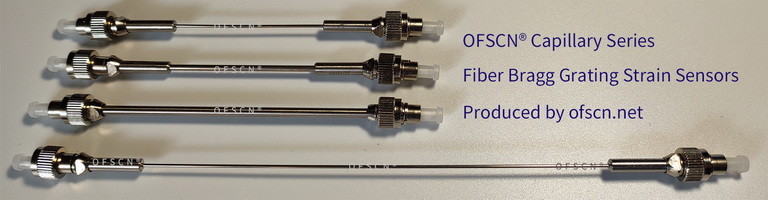
Double-ended OFSCN® Capillary Seamless Steel Tube FBG Sensors can also be used in series for the measurement of multiple physical quantities or mixed measurements (stress, strain, e temperature). In this case, each sensor needs to be customized with a different wavelength to distinguish different reflection wavelengths.
 |
|
Figura 3 |
OFSCN® Capillary Seamless Steel Tube FBG Sensors produced by DCYS typically have a standard wavelength range near the C-band (approximately between 1525nm and 1565nm). Altro wavelength products can be customized according to customer requirements.
Our philosophy is: 'OFSCN®, make optical fiber stronger!'
DCYS is a professional wavelength-customized Fiber Bragg Grating sensor manufacturer, providing customized wavelength FBG temperature sensors, C-band center wavelength FBG stress-strain sensors and Altro information; the brand of FBG sensors with customizable wavelengths is 'OFSCN'.