
Enciclopedia della Tecnologia di Rilevamento a Reticolo di Bragg su Fibra - FAQ FBG - FAQ Sensore FBG - FAQ Demodulatore FBG - Analisi dei Problemi Comuni di Applicazione FBG
Svantaggi intrinseci delle reti di Bragg su fibra, Sfide di confezionamento dei sensori a rete di Bragg su fibra e Principi di compensazione della temperatura per i sensori a rete di Bragg su fibra
This article analyzes the inherent drawbacks of fiber Bragg gratings (FBGs), which pose technical challenges in the packaging of fiber Bragg grating sensors (FBG sensors). It also introduces the accurate fiber Bragg grating temperature sensor (Bragg fiber grating thermometer) e proposes temperature compensation solutions for fiber Bragg grating stress sensors e fiber Bragg grating strain sensors developed by DCYS. The article also mentions fiber Bragg grating strings/arrays (FBGs) e serial fiber Bragg grating sensors with FBGs (serial FBG sensors ).
Nell'articolo precedente, 'Principi di Base dei Reticoli di Bragg su Fibra e Sensori a Reticolo di Bragg su Fibra - Parte 2: Principi di Rilevamento FBG,' abbiamo appreso che i reticoli di Bragg su fibra (FBG) possono misurare direttamente quantità fisiche fondamentali come stress, deformazione e temperatura. Questa misurazione diretta è possibile perché il periodo del reticolo (passo del reticolo) degli FBG è direttamente correlato a tre parametri fisici di base: forza (forza di trazione o compressione), lunghezza (allungamento o contrazione) e temperatura (riscaldamento o raffreddamento). Tra questi cambiamenti, le variazioni di forza e temperatura sono considerate cause, mentre i cambiamenti di lunghezza sono considerati risultati (come mostrato nella Figura 1).
 |
|
Figura 1 |
Le conclusioni sopra menzionate costituiscono la base teorica per il rilevamento con reticoli di Bragg su fibra (FBG) e sensori a reticolo di Bragg su fibra (sensori FBG). Tuttavia, esse presentano anche una nuova sfida o difficoltà tecnica, che è lo svantaggio intrinseco dei reticoli di Bragg su fibra.
1. Svantaggi dei Reticoli di Bragg su Fibra (FBG) e Sfide di Incapsulamento dei Sensori a Reticolo di Bragg su Fibra (Sensori FBG)
The problem we face is that when using a fiber Bragg grating (FBG) e a fiber Bragg grating sensor (FBG sensor) for sensing e detection, we observe a change in the reflected wavelength (corresponding to the change in grating pitch). The challenge lies in determining whether this change is caused by force variations or temperature variations.
A meno che questa questione non venga affrontata, è impossibile determinare il tipo di sensore a reticolo di Bragg su fibra utilizzato (sensore di temperatura a reticolo di Bragg su fibra, sensore di stress a reticolo di Bragg su fibra o sensore di deformazione a reticolo di Bragg su fibra). Inoltre, è difficile garantire l'accuratezza delle misurazioni ottenute dai sensori a reticolo di Bragg su fibra.
2. Iniziare con un Sensore di Temperatura a Reticolo di Bragg su Fibra Accurato
In this remarkable era, DCYS has been fortunate to stand on the shoulders of giants in multiple industries e has creatively combined the modern metallurgical pipe manufacturing industry with the fiber Bragg grating sensing industry. As a result, we have developed our own solution to address the challenge of separating temperature e stress/strain in fiber Bragg gratings (FBGs) e fiber Bragg grating sensors (FBG sensors). This solution has led to the creation of the OFSCN® capillary Seamless Steel Tube Fiber Bragg Grating Sensor series (refer to Figures 2 e 3 for the packaging structure of the fiber Bragg grating sensor).
 |
|
Figura 2 |
 |
|
Figura 3 |
Figura 2 shows the OFSCN® capillary Seamless Steel Tube Fiber Bragg Grating Temperature Sensor (Type 01). We can confidently state that this fiber Bragg grating temperature sensor perfectly achieves the separation of temperature and stress/strain, both in principle and in practical measurements. We will provide further details and experimental evidence in subsequent articles.
This product also offers high sensitivity, fast heat conduction, excellent accuracy, compact size, light weight, high tensile and compressive strength, high temperature resistance, corrosion resistance, water and moisture resistance, non-combustibility, and Altro characteristics. It is an innovative Bragg fiber grating temperature sensor. With this product, we hope that DCYS can help advance the entire fiber Bragg grating sensing industry and contribute to its further development.
3. Principi di Compensazione della Temperatura per Sensori di Stress a Reticolo di Bragg su Fibra e Sensori di Deformazione a Reticolo di Bragg su Fibra
Figura 3 shows the OFSCN® capillary Seamless Steel Tube Fiber Bragg Grating Stress/Strain Sensor (Type 02). Although this product does not achieve temperature and stress/strain separation independently, it can be used in conjunction with the OFSCN® capillary Seamless Steel Tube Fiber Bragg Grating Temperature Sensor (Type 01) to address the challenge of temperature and stress/strain separation, as depicted in Figure 4.
 |
|
Figura 4 |
4. Concetto di Stringhe/Array di Reticoli di Bragg su Fibra (FBG) e Sensori Seriali a Reticolo di Bragg su Fibra (Sensori FBG con FBG)
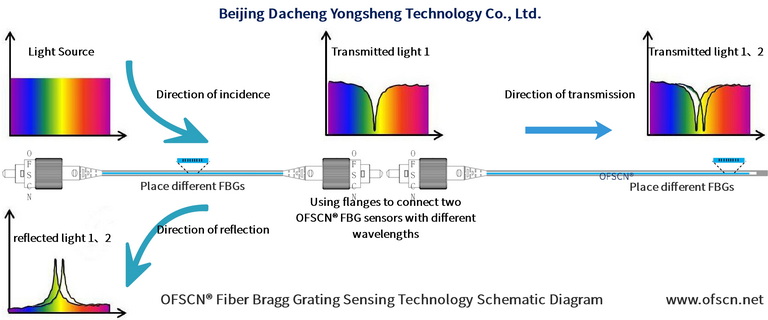
To better understand the previous diagram, let's first supplement some basic knowledge about fiber Bragg gratings (FBGs). One of the flexible features of fiber Bragg grating sensors is the ability to achieve multipoint sensing. In theory, we can inscribe numerous FBGs with different wavelengths in a single sensor, enabling distributed detection of one or multiple physical parameters (corresponding to the OFSCN® Capillary Seamless Steel Tube Distributed Fiber Bragg Grating Sensor).
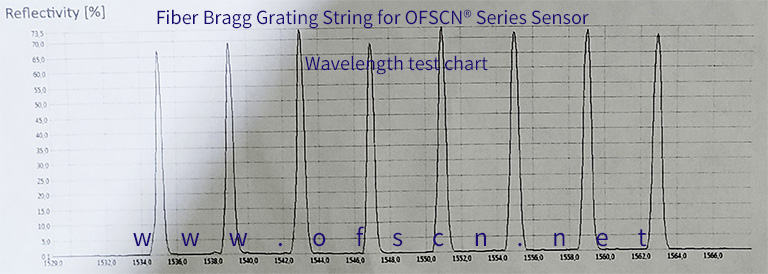
Per un esempio specifico, fare riferimento alla Figura 5, che illustra una fibra con nove FBG di diverse lunghezze d'onda. Questa configurazione consente la misurazione simultanea in nove punti diversi.
 |
|
Figura 5 |
 |
|
Figura 6 La Figura 6 mostra la distribuzione della lunghezza d'onda di un array di reticoli di Bragg su fibra (FBG) a otto canali su un analizzatore di spettro ottico. |
5. Compensazione della Temperatura per Sensori a Reticolo di Bragg su Fibra
Returning to the example in Figura 4, we use two OFSCN® Capillary Seamless Steel Tube Fiber Bragg Grating Sensors, Sensor 1 and Sensor 2, with different wavelengths. Sensor 1 is sensitive to both temperature and stress/strain, while Sensor 2 is only sensitive to temperature. They are placed in the same environment, with the same temperature. For Sensor 1, the change in wavelength includes the influence of both temperature and stress/strain. However, we already know its temperature accurately (from Sensor 2), so we can subtract the temperature's impact on the wavelength change, leaving only the effect of stress/strain (calculation details can be found in the formula: ΔλB =λB(1-Pe)Δε+λB(αf-ξ)ΔT).
In questa configurazione del sensore, il Sensore 1 diventa un sensore di stress a reticolo di Bragg su fibra e un sensore di deformazione a reticolo di Bragg su fibra calibrati con precisione (questo processo di calcolo è noto come compensazione della temperatura per i sensori a reticolo di Bragg su fibra).
The OFSCN® Capillary Seamless Steel Tube Fiber Bragg Grating Temperature Sensor can also be used for temperature compensation in Altro applications, such as fiber Bragg grating vibration sensors, fiber Bragg grating shape sensors, fiber Bragg grating gas sensors, and fiber Bragg grating pressure sensors.
Based on the above discussion, the OFSCN® Capillary Seamless Steel Tube Fiber Bragg Grating Sensors produced by DCYS successfully achieve the separation of temperature and stress/strain, overcoming the inherent drawbacks of fiber Bragg gratings. The key lies in the fact that the OFSCN® Capillary Seamless Steel Tube Fiber Bragg Grating Temperature Sensor provides accurate temperature measurement unaffected by stress/strain. How does DCYS achieve this? The principles and mysteries will be revealed in the Successivo article. Stay tuned!
Our philosophy is: 'OFSCN®, make optical fiber stronger!'
DCYS is a professional manufacturer of high accuracy fiber bragg grating temperature sensor, providing high accuracy FBG temperature sensor temperature measurement accuracy principle, temperature compensation principle, temperature measurement inaccuracy solutions and Altro information; high accuracy FBG temperature sensor brand 'OFSCN'.