
موسوعة تقنية استشعار شبكة براج الليفية - أسئلة متكررة FBG - أسئلة متكررة مستشعر FBG - أسئلة متكررة لجهاز إزالة تعديل FBG - تحليل مشاكل التطبيق الشائعة لـ FBG
التجربة الأولى لمستشعر درجة الحرارة FBG (شبكة براغ الليفية) - تأثير قوة الشد والإجهاد والانفعال على مقياس حرارة FBG
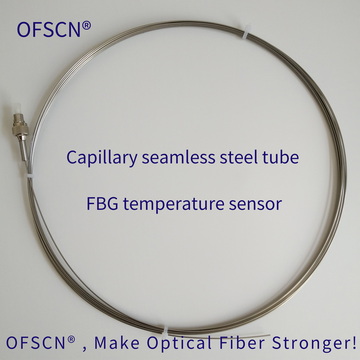
In this article, we conducted a tensile experiment on OFSCN® Capillary Seamless Steel Tube Fiber Bragg Grating temperature sensors (FBG thermometers). The experiment tested the temperature-wavelength relationship of the fiber Bragg grating (FBG) under different tensile conditions.
Through the experimental report و error analysis, we demonstrated that OFSCN® Capillary Seamless Steel Tube temperature sensors (FBG thermometers) produced by OFSCN overcome the inherent drawbacks of FBG sensors (temperature و strain/stress cross-sensitivity) و exhibit accuracy و high precision in practical use.
في مقال سابق بعنوان "عيوب وتحليل القوة لأجهزة استشعار درجة الحرارة التقليدية لشبكة الألياف Bragg (مقاييس الحرارة FBG) - أسباب قياس درجة الحرارة غير الدقيق"، we analyzed the three forces that the fiber Bragg grating (FBG) in traditional FBG sensors may experience. In the new OFSCN® Capillary Seamless Steel Tube Fiber Bragg Grating temperature sensors (FBG thermometers), the FBG remains completely free from any external forces.
لإثبات هذه النقطة، نقوم بإجراء التجربة الأولى، 'تجربة الشد'. فيما يلي التقرير التجريبي وتحليل البيانات:
 |
|
الشكل 1 |
|
|
| الشكل 2 |

أولاً. هدف التجربة
To verify that OFSCN® Capillary Seamless Steel Tube temperature sensors (FBG thermometers) produced by DCYS are minimally affected by external forces during construction و use, و that the fiber Bragg grating (FBG) inside the sensors does not experience stress or strain.
ثانياً. المعدات التجريبية
Fiber Bragg grating demodulator, OFSCN® Capillary Seamless Steel Tube Fiber Bragg Grating temperature sensor (FBG thermometer), tensile gauge, mercury thermometer, temperature-controlled chamber.
ثالثاً. الطريقة التجريبية
In this experiment, an OFSCN® Capillary Seamless Steel Tube Fiber Bragg Grating temperature sensor (FBG thermometer) was connected to a fiber Bragg grating demodulator. The sensor was clamped و fixed using a fixture near the fiber junction, و a tensile gauge was attached to the rear end of the sensor using another fixture. The sensing part of the sensor, which includes the fiber Bragg grating (FBG), was placed inside the temperature-controlled chamber.
Under different tensile conditions, the fiber Bragg grating (FBG) wavelength in the OFSCN® Capillary Seamless Steel Tube Fiber Bragg Grating temperature sensor (FBG temperature sensor) was read using the fiber Bragg grating demodulator. The experiment was completed after comparison.
رابعاً. الإجراء التجريبي وتحليل البيانات
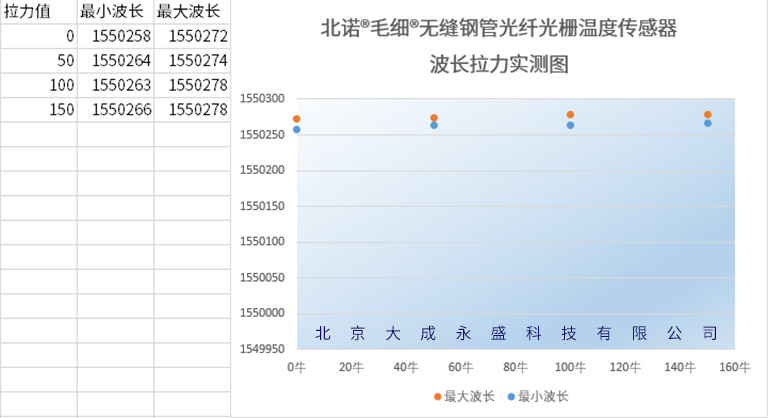
Since the wavelength of the fiber Bragg grating (FBG) is related to the ambient temperature و the applied tensile force, the experimental procedure needed to consider temperature variations. The experiment first collected the temperature inside the temperature-controlled chamber, which fluctuated between 52.5 و 53.1 degrees Celsius. At this temperature, the center wavelength of the NO.3 OFSCN® Capillary Seamless Steel Tube Fiber Bragg Grating temperature sensor (FBG thermometer) was recorded in its natural state, with a wavelength range of 1550258 to 1550272.
A tensile force of 50 Newtons was applied, و after a 10-minute rest to eliminate the influence of manual operations, the center wavelength of the NO.3 OFSCN® Capillary Seamless Steel Tube Fiber Bragg Grating temperature sensor (FBG thermometer) was recorded, with a wavelength range of 1550264 to 1550274.
A tensile force of 100 Newtons was applied, و after a 10-minute rest to eliminate the influence of manual operations, the center wavelength of the NO.3 OFSCN® Capillary Seamless Steel Tube Fiber Bragg Grating temperature sensor (FBG thermometer) was recorded, with a wavelength range of 1550263 to 1550278.
A tensile force of 150 Newtons was applied, و after a 10-minute rest to eliminate the influence of manual operations, the center wavelength of the NO.3 OFSCN® Capillary Seamless Steel Tube Fiber Bragg Grating temperature sensor (FBG thermometer) was recorded, with a wavelength range of 1550266 to 1550278.
تظهر المجموعة الكاملة من تحليل البيانات التجريبية في الشكل 1.
 |
|
الشكل 3 |
خامساً. الاستنتاج التجريبي
Based on the above experimental data, it can be concluded that OFSCN® Capillary Seamless Steel Tube Fiber Bragg Grating temperature sensors (fiber Bragg grating temperature sensors) produced by DCYS are minimally affected by external forces during construction و use. Regardless of how the external tensile force changes, the force acts on the seamless steel tube used in the sensor, و the fiber Bragg grating (FBG) inside the sensor does not experience stress or strain. This effectively solves the technical challenge of temperature و strain/stress cross-sensitivity in traditional fiber Bragg grating sensors (FBG sensors).
Our philosophy is: 'OFSCN®, make optical fiber stronger!'
DCYS is a professional manufacturer of fiber bragg grating temperature sensors with accurate temperature measurement. It provides information such as test و verification methods, verification experiments, و test reports for accurate temperature measurement of FBG temperature sensors. The brand of FBG temperature sensors with accurate temperature measurement is 'OFSCN'.