
Enciclopédia da Tecnologia de Sensoriamento por Grade de Bragg em Fibra - FAQ FBG - FAQ Sensor FBG - FAQ Demodulador FBG - Análise de Problemas Comuns de Aplicação FBG
Princípios Básicos de Grades de Bragg em Fibra e Sensores de Grade de Bragg em Fibra - Parte 1: Reflexão e Interferência de Ondas
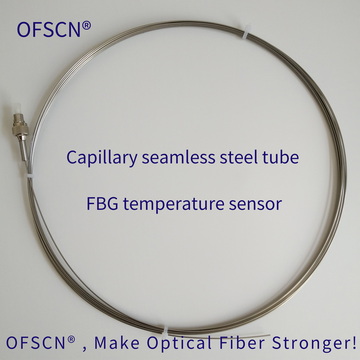
This article explains the necessary knowledge of wave reflection e interference (interference) to understand the basic principles of fiber bragg gratings. It serves as a preliminary educational article about OFSCN® capillary seamless steel tube FBG sensors produced by DCYS.
In the previous article 'OFSCN® capillary seamless steel tube FBG Sensors,' we provided the definition of OFSCN® capillary seamless steel tube FBG sensors. We also introduced DCYS as a professional manufacturer of FBG sensors, highlighting the unique features of the OFSCN® capillary seamless steel tube FBG sensor series due to the use of advanced materials e structures.
To enhance your understanding of DCYS's products, we will now focus on explaining the basic principles of FBG sensors (including FBG principles). This article is an educational piece e not a research article. If any readers find fundamental errors in this article, please provide feedback.
 |
|
Imagem 1 |
 |
| Imagem 2 |
Uma vez que este é um artigo educacional, por favor, acredite que não será difícil. Antes de discutir os princípios dos sensores FBG, precisamos entender a reflexão e a interferência (interferência) das ondas. Isso ocorre porque a parte mais crucial dos sensores FBG é a detecção precisa da luz refletida em um comprimento de onda específico. Ao analisar as mudanças no comprimento de onda da luz refletida, podemos determinar as quantidades físicas correspondentes que estão sendo medidas (como tensão, deformação e temperatura).
Como as ondas de luz têm altas frequências e curtos comprimentos de onda, elas não são facilmente observáveis em nossas vidas diárias, a menos que sejamos profissionais da área. Para facilitar a compreensão, usaremos ondas sonoras como analogia para representar as ondas de luz - tanto as ondas sonoras quanto as ondas de luz exibem características de onda, com ondas longas e curtas.
1. Reflexão de uma Única Onda Sonora (Onda de Luz)
You may have encountered the following scenario in your life: One day, while traveling to a scenic place with mountains, you stand in front of a mountain and shout, 'OFSCN®...' (or you can shout 'DCYS' or the name of your loved one). Suddenly, you hear the echo of the mountain saying 'OFSCN®...' This echo represents the reflection of the sound wave (see Imagem 3). You emitted a sound wave (incident wave) towards the mountain, and the mountain responded with a corresponding wave reflection (reflected wave).
 |
|
Imagem 3 |
2. Reflexão de Múltiplas Ondas Sonoras (Ondas de Luz)
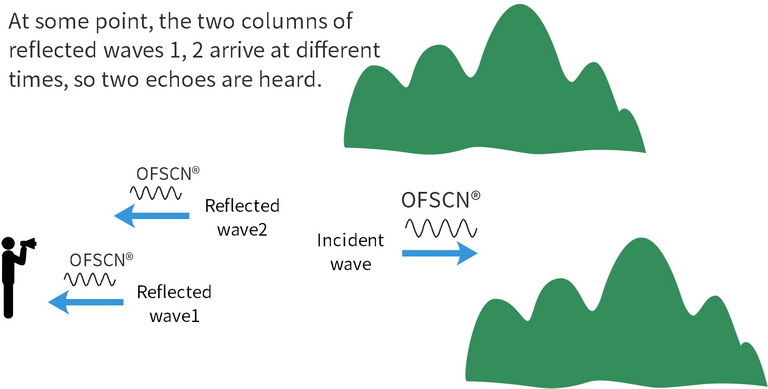
Continuing forward, you enter a valley and shout, 'OFSCN®...' into the valley. Then, you hear echoes from both sides of the valley, saying 'OFSCN®...' repeatedly. These echoes from both sides of the valley represent the reflection of two or more columns of sound waves (see Imagem 4).
 |
|
Imagem 4 |
3. Interferência de Múltiplas Ondas Sonoras (Ondas de Luz)
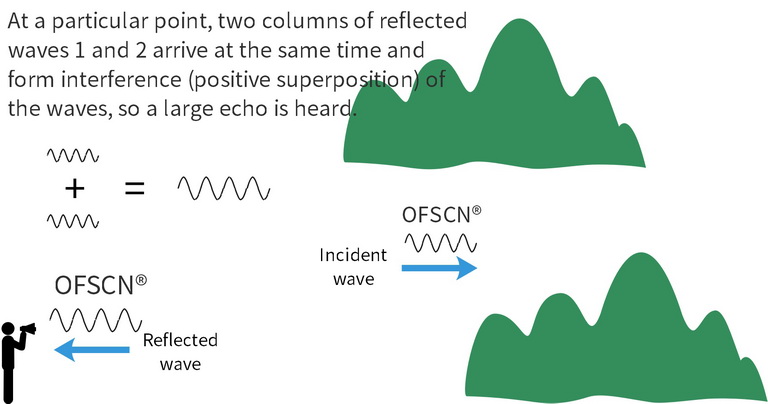
By coincidence, you reach a particular spot in the valley (there must be a series of such spots along your journey). Here, you shout, 'OFSCN®...' again, and suddenly, the echoes from both sides of the valley merge into a tremendous sound, resonating in your head. What happened? At this moment, the two or more columns of sound waves have interfered with each other (arriving simultaneously, forming constructive interference, see Imagem 5).
 |
|
Imagem 5 |
Assim como as ondas sonoras, as ondas de luz exibem características semelhantes em uma escala menor. As ondas de luz que atendem a certas condições (condição de Bragg) ao passar por uma FBG também sofrem interferência construtiva, resultando em múltiplas ondas refletindo positivamente (interferência).
As this article serves as a preliminary educational article about OFSCN® capillary seamless steel tube FBG sensors produced by DCYS, we will not discuss the negative interference of two or more sound waves that may occur at a few meters apart. In FBG sensors, what we need to detect is the constructive interference of multiple waves.
A esta altura, você pode ter adquirido uma certa compreensão da reflexão e interferência (interferência) das ondas sonoras (ondas de luz). Além de belas montanhas, você também pode experimentar as características de onda mencionadas neste artigo no Templo do Céu em Pequim. O parque possui uma parede de eco, e há também pedras de três tons no Salão da Oração pelas Boas Colheitas.
Vale ressaltar que as características das ondas sonoras também se aplicam às ondas de luz transmitidas em fibras ópticas. Quando as ondas de luz encontram as FBGs, elas sofrem reflexão e interferência (interferência) de acordo com os mesmos princípios. No entanto, a reflexão das ondas de luz dentro das fibras ópticas é mais complexa, envolvendo conhecimento detalhado da teoria de acoplamento e reflexão de modos. Para aqueles que desejam explorar mais, consultem recursos relevantes. No próximo artigo, explicaremos como as FBGs funcionam com base nas ondas de luz. Fiquem ligados!
Our philosophy is: 'OFSCN®, make optical fiber stronger!'
DCYS is a professional fiber bragg grating sensor manufacturer, providing the principle of FBG, the principle of temperature measurement of FBG sensors, the principle of stress measurement, the principle of strain, the principle of temperature compensation e the principle of patented seamless steel pipe packaging; the brand of FBG sensors is 'OFSCN'.