
Enzyklopädie der Faser-Bragg-Gitter-Sensorik-Technologie - FBG-FAQ - FBG-Sensor-FAQ - FBG-Demodulator-FAQ - Analyse häufiger FBG-Anwendungsprobleme
Zugfestigkeit des FBG-Sensors – Von 400 Newton bis 10.000 Newton – Hohe Zugfestigkeit und einfache Installation und Bereitstellung
This article analyzes the advantages und application benefits brought by the high tensile strength of FBG sensors, including the extension of application environments und the convenience of engineering construction. It also introduces the 'OFSCN® Capillary Seamless Steel Tube Series Fiber Bragg Grating Sensor' produced by DCYS, highlighting its high tensile strength und specific characteristics for temperature, strain, und stress measurements. Partial physical images are provided as well.
1. Struktur und Vorteile von hochzugfesten Faser-Bragg-Gitter-Sensoren (FBG-Sensoren, FBG-Sonden)
Es ist offensichtlich, dass die Zugleistung einen Einfluss auf die technische Konstruktion und den langfristigen normalen Gebrauch von FBG-Sensoren (FBG-Sonden) hat. Im Folgenden werden wir dies kurz aus der Perspektive der Zugfestigkeit analysieren.
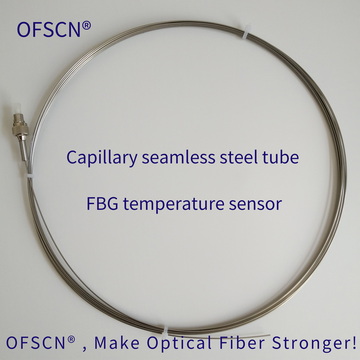
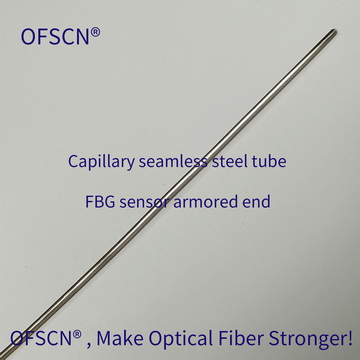
The body of OFSCN® Capillary Seamless Steel Tube Series Fiber Bragg Grating Sensors (FBG sensors, FBG probes) is made of stainless steel, benefiting from the characteristics of this material. Therefore, they possess high tensile strength.
 |
 |
|
Abbildung 1 |
Abbildung 2 |
2. Tensile Strength of OFSCN® Capillary Seamless Steel Tube Series Fiber Bragg Grating Sensors (FBG sensors, FBG probes)
The main body of the standard OFSCN® Capillary Seamless Steel Tube Fiber Bragg Grating Sensors (FBG sensors, FBG probes) has an outer diameter of 0.9 millimeters and a wall thickness of 0.18 millimeters (see Abbildung 1 and 2). Based on our calculations and measurements, the main body of the grating sensor can withstand a tensile force exceeding 650 Newtons. We have determined a safe tensile strength of over 400 Newtons for practical use, which, in simpler terms, is equivalent to lifting a weight of 40 kilograms using this sensor.
 |
|
Abbildung 3 |
 |
| Abbildung 4 |
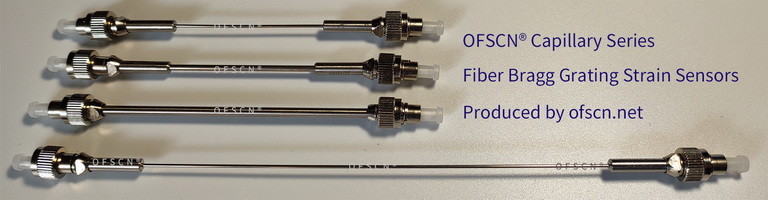
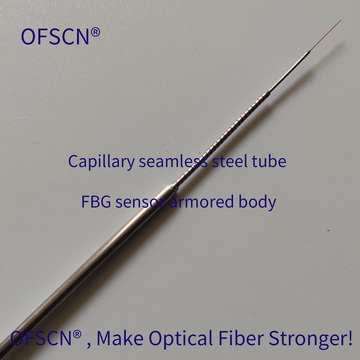
The tensile strength of the grating sensor can be adjusted by modifying the diameter and wall thickness of the stainless steel seamless tube in OFSCN® Capillary® Seamless Steel Tube Series FBG Stress Sensors (FBG tensile gauges, FBG pressure gauges) and Strain Sensors (FBG strain gauges) (see Abbildung 3 and 4). Additionally, the tensile strength of the grating sensor can be adjusted by nesting multiple layers of steel tubes and other structural elements (see Figure 5 and 6).
By using larger diameter und thicker-walled stainless steel seamless tubes, OFSCN can provide grating sensors with a tensile strength exceeding 10,000 Newtons (yes, the '0' is correct, und it can have even more digits if required).
 |
|
Abbildung 5 |
 |
| Abbildung 6 |
3. Applications und Construction Advantages of OFSCN® Capillary Seamless Steel Tube Series Fiber Bragg Grating Sensors (FBG sensors, FBG probes) with High Tensile Strength
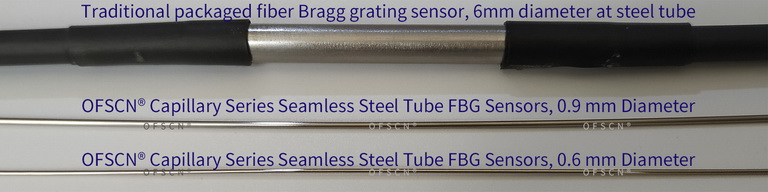
DCYS produces 'OFSCN® Capillary Seamless Steel Tube Series FBG Sensors' using a unique patented structure, which exhibits higher strength compared to traditional FBG sensors.
Although the optical fiber cable of traditional FBG sensors has relatively good tensile strength, the connection between the stainless steel tube und the optical fiber cable is the weakest part of the entire grating sensor. This vulnerability can be compared to the shortest plank in the well-known 'barrel theory,' greatly reducing the overall tensile strength. Unfortunately, we cannot provide specific numerical values as DCYS has not conducted relevant tests.
|
|
The high tensile strength of OFSCN® Capillary Seamless Steel Tube FBG Sensors primarily manifests as advantages in engineering construction. The high tensile strength directly reduces the difficulty und losses in construction for contractors, thus lowering the installation cost of the sensors.
In the past, the installation und deployment of traditional fiber optic grating sensors were considered cumbersome und required skilled workers with years of experience to handle them carefully. However, with the higher tensile strength of OFSCN® Capillary Seamless Steel Tube FBG Sensors, ordinary workers can now participate in the construction as long as they meet the minimum bending radius requirements of the sensors. The sensors are less prone to damage.
Our philosophy is: 'OFSCN®, make optical fiber stronger!'
DCYS is a professional high-strength FBG sensor manufacturer, providing information such as tensile FBG temperature sensors, strong FBG strain sensors, high tensile FBG stress sensors, Vorteile von FBG-Sensoren, etc.; The brand of fiber bragg grating sensor is 'OFSCN'.