
Enciclopedia de tecnología de detección de rejilla de Bragg de fibra - Preguntas frecuentes sobre FBG - Preguntas frecuentes sobre sensores FBG - Preguntas frecuentes sobre demoduladores FBG - Análisis de problemas comunes de aplicación de FBG
Coeficiente del sensor de temperatura de Red de Bragg de Fibra (FBG) de femtosegundos - Función de Calibración de Fábrica para termómetro FBG de 500°C, Rango de -4.6℃ a 450℃
OFSCN® 500°C Capillary Seamless Steel Tube Fiber Bragg Grating Temperature Sensors (FBG Thermometers) produced by DCYS undergo calibration before leaving the factory, y the basic temperature coefficients (also known as calibration coefficients or calibration functions) for the fiber bragg grating sensors are provided along with the product. Here is a brief explanation of the calibration for this product:
Tabla de Contenidos:
| 1. Estructura del producto del sensor de temperatura de rejilla de Bragg de fibra de femtosegundos |
1.Product Structure of OFSCN® 500°C Capillary® Seamless Steel Tube Femtosecond Fiber Bragg Grating Temperature Sensor:
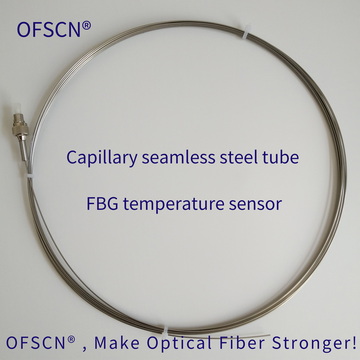
OFSCN® 500°C Capillary Seamless Steel Tube Fiber Bragg Grating Temperature Sensors (FBG Thermometers) are protected by a full-metal encapsulation to safeguard the fiber bragg grating (FBG). The standard product has a diameter of 2.0 millimeters and features a three-layer metal pipe nested structure. It encapsulates a high-temperature-resistant femtosecond fiber bragg grating (Femtosecond FBG). The overall structure and the product itself are shown in Figura 1, 2, and 3:
 |
|
|
Figura 1 |
|
 |
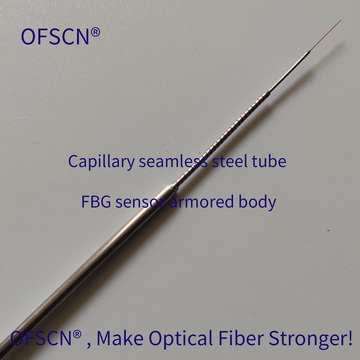 |
| Figura 2 |
Figura 3 |
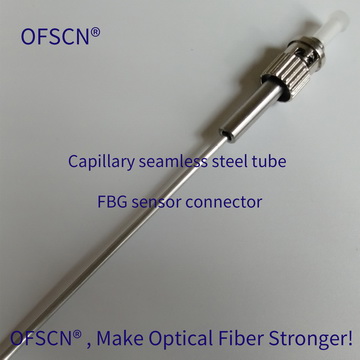
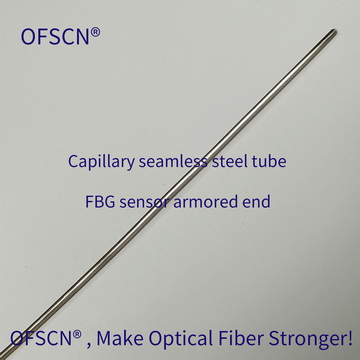
Los conectores y los extremos de cola se ilustran en las Figuras 4 y 5:
 |
 |
|
Figura 4 |
Figura 5 |
2. Factory Test Report for OFSCN® 500°C Capillary Seamless Steel Tube Femtosecond Fiber Bragg Grating Temperature Sensor - Calibration Coefficient Graph:
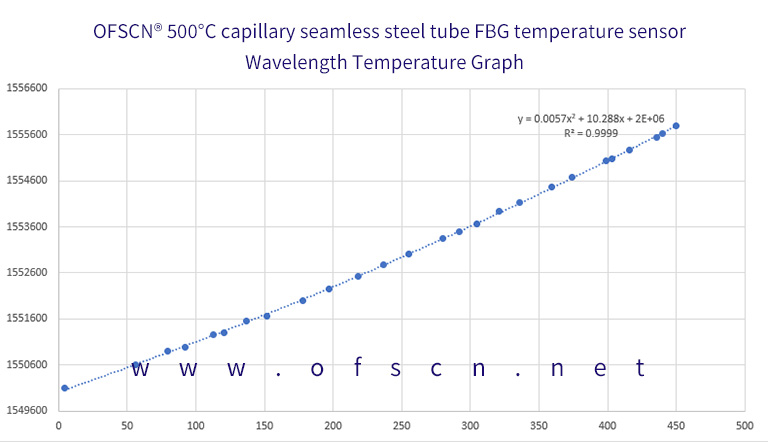
High accuracy is the lifeline of DCYS's products, y this characteristic is verified through the test reports of each sensor we produce, as shown in the following figure:
 |
| Figura 6 |
Figura 6 shows the measured graph of the calibration coefficient (calibration function) of an actual sold OFSCN® 500°C Capillary Seamless Steel Tube Fiber Bragg Grating Temperature Sensor (FBG Thermometer). This curve displays the corresponding relationship between the sensor's wavelength variation and temperature change. As this sensor can be used at higher temperatures, we provide calibration for temperatures ranging from room temperature to 450°C, with calibration temperature intervals of approximately 30°C (not strictly enforced).
A diferencia de la leyenda, en el informe formal de fábrica, también proporcionamos valores específicos de longitud de onda y temperatura. Para mediciones de temperatura generales, este coeficiente de calibración puede utilizarse directamente.
Each OFSCN® 500°C Capillary Seamless Steel Tube Fiber Bragg Grating Temperature Sensor has a unique calibration coefficient (calibration function), which is tested y determined by the Quality Inspection Department of DCYS. It is recorded on the company's official website for customers to query at any time. Based on our experience, the R-square value of the binomial function is generally above 0.9995.
Our philosophy is: 'OFSCN®, make optical fiber stronger!'
DCYS is a professional 500°C FBG temperature sensor manufacturer, providing 500°C FBG temperature sensor calibration method, calibration experiment, test report, temperature coefficient, calibration function and Otros information; 500°C fiber bragg grating temperature sensor brand is 'OFSCN'.