
Fiber Bragg Grating Algılama Teknolojisi Ansiklopedisi - FBG SSS - FBG Sensör SSS - FBG Demodülatör SSS - FBG Yaygın Uygulama Problemleri Analizi
Fiber Bragg Kafesleri ve Fiber Bragg Kafes Sensörlerinin Temel Prensipleri - Bölüm 2: FBG Algılama Prensipleri
This article explains the basic principles of FBG based on actual optical waves. It helps readers understand the underlying mechanisms of FBG sensors, FBG strain sensors, ve FBG temperature sensors. This article serves as a preliminary introduction to the OFSCN® capillary seamless steel tube FBG sensors produced by DCYS.
Önceki makalede, 'Fiber Bragg Izgaralarının ve Fiber Bragg Izgaralı Sensörlerin Temel İlkeleri - Bölüm 1: Dalgaların Yansıması ve Girişimi,' we used sound waves as an analogy to understand the principles of OFSCN® capillary seamless steel tube FBG sensors, specifically the reflection ve interference (interference) of waves.
Bugün, bu temel üzerine FBG sensörlerinin (FBG prensipleri dahil) temel ilkelerini tanıtacağız. Bu makale aynı zamanda popüler bilim makalesi olup bir araştırma makalesi değildir. Bu makalede herhangi bir hata bulan olursa lütfen nazikçe belirtin.
 |
| Resim 1 |
1. Fiber Bragg Grating (FBG) Sensöründeki Fiber Bragg Grating (FBG)
FBG Sensörü bir tür optik fiber sensördür. Algılama süreci, algılama bilgisi elde etmek için FBG'nin dalga boyunun harici fiziksel parametreler tarafından modülasyonuna dayanır. Bu bir dalga boyu modülasyonlu optik fiber sensördür.
Yukarıdaki resim, bir FBG (gerçek çapı 9 mikrometre) içeren bir optik fiber çekirdeğinin şematik diyagramını göstermektedir. Fotomaske yoluyla UV ışığına maruz bırakma, femtosaniye lazerle nokta nokta yazma veya diğer işleme teknikleri gibi yöntemler kullanılarak, optik fiber çekirdeğinde aynı aralığa sahip çok sayıda zayıf yansıma yüzeyi (burada daha karmaşık ızgaraları tartışmayacağız) oluşturulur. Bu zayıf yansıma yüzeylerine optik fiber ızgaraları denir ve her zayıf yansıma yüzeyi arasındaki mesafeye ızgara adımı veya ızgara periyodu denir (Λ sembolü ile gösterilir - lütfen bu sembolü unutmayın, çünkü sonraki metinde kullanılacaktır).
 |
2. FBG ve FBG Sensörünün Algılama İlkeleri
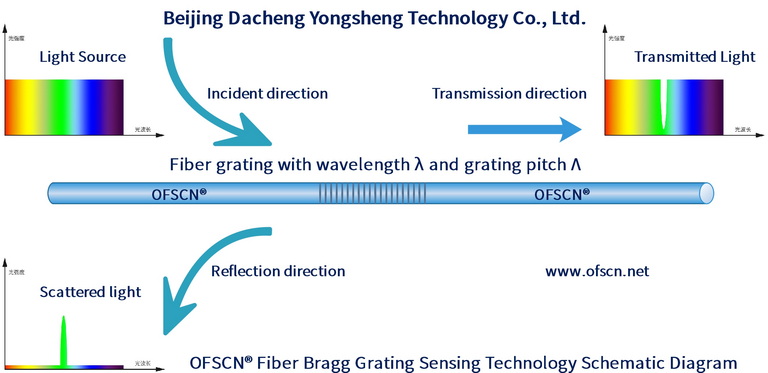
Yukarıda bahsedilen FBG kullanılarak temel algılama ölçümleri yapılabilir. İlke Resim 3'te gösterilmiştir.
 |
3. Fomula of FBG ve FBG Sensor Principle
The middle section of Resim 3 represents a FBG or an encapsulated OFSCN® capillary seamless steel tube FBG Sensor. Broadband incident light enters the FBG sensor from one end of the grating. When the light encounters the FBG, most wavelengths of light pass through the FBG as transmitted light, while a small portion of specific wavelengths of light are reflected back (please note these specific wavelengths, which are the object of our detection and are represented by λB). There is a direct relationship between λB and the grating pitch (grating period) Λ we mentioned earlier, expressed by the mathematical formula: λB = 2neffΛ, where λ represents the reflected wavelength, neff is the refractive index of the optical fiber core, and Λ is the grating pitch (grating period).
Yansıyan ışık daha sonra FBG demodülatörüne (diyagramda etiketlenmemiş) girer ve bir dalga boyu sinyali λB'ye dönüştürülür. FBG sensörü FBG algılama cihazına bağlı olduğundan, her an farklı bir test dalga boyu sinyali λB elde edebiliriz. Önceki matematiksel ifadeden, bir sonraki anda geri dönen dalga boyu sinyali λ'nın neden değiştiğini (ΔλB ile temsil edilir) anlayabiliriz. Temel neden, fiber optik ızgarasının ızgara adımı (ızgara periyodu) Λ'nın değişmiş olmasıdır (ΔΛ ile temsil edilir).
4. Sıcaklık, Gerinim ve Gerilme Ölçümü için FBG ve FBG Sensör İlkeleri
Şimdi, karmaşık matematiksel sembollerden uzaklaşalım ve gerçek dünya senaryolarını hayal edelim. Izgara adımında (ızgara periyodu) Λ'da bir değişikliğe ne sebep olabilir?
İlk olası nedeni zaten tahmin etmiş olabilirsiniz: kuvvet. FBG'ye gerilim uyguladığınızda uzar, sıkıştırma uyguladığınızda ise büzülür.
İkinci olası neden sıcaklıktır. FBG ısıtıldığında genişler ve uzar, soğutulduğunda ise büzülür ve küçülür.
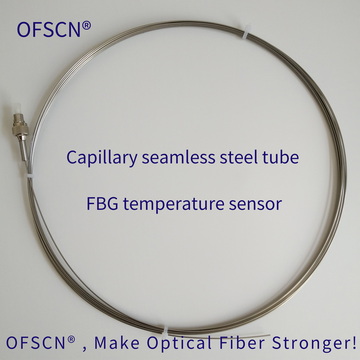
During this process, clever individuals have associated the accurately detectable wavelength signals with three basic physical parameters: force (tension, compression), length (elongation, contraction), ve temperature (heating, cooling). Therefore, the basic physical quantities that FBG Sensors can directly measure include stress, strain, ve temperature (corresponding to OFSCN® capillary seamless steel tube FBG stress sensors, OFSCN® capillary seamless steel tube FBG strain sensors, ve OFSCN® capillary seamless steel tube FBG temperature sensors, respectively).
 |
|
Şekil 4 |
As an introductory article about the OFSCN® capillary seamless steel tube series FBG sensor, we have simplified the mathematical calculations ve considered the wavelength changes caused by stress, strain, ve temperature. The mathematical calculation process for wavelength changes is more complex than the simple equation 'λB = 2neffΛ' we presented earlier. This complexity arises because the refractive index neff of the fiber optic core is also a variable. The overall formula is as follows: ΔλB = λB(1 - Pe)Δε + λB(αf - ξ)ΔT, but we will not delve into it here.
Bu noktada, FBG'lerin ve FBG sensörlerinin çalışma prensipleri hakkında belirli bir anlayış kazanmış olabilirsiniz. Peki, teorik FBG'den pratik kapsüllenmiş FBG Sensörlerine geçişte başka hangi zorluklar mevcut? Bu zorluklar nasıl ele alınabilir? Bunları sonraki bölümlerde tartışacağız, bu yüzden takipte kalın!
Our philosophy is: 'OFSCN®, make optical fiber stronger!'
Ek 1:
İlgili video tanıtımı:
DCYS is a professional fiber bragg grating sensor manufacturer, providing the principle of FBG, FBG sensor temperature measurement principle, stress measurement principle, strain principle, temperature compensation principle ve seamless steel tube packaging principle; the brand of FBG sensor is 'OFSCN '.