
Faser-Bragg-Gitter-Sensortechnologie-Enzyklopädie - FBG-FAQ - FBG-Sensor-FAQ - FBG-Demodulator-FAQ - FBG-Häufige Anwendungsproblemanalyse
Temperaturbereich des Faser-Bragg-Gitter-Temperatursensors - Temperaturbereich: Hochtemperaturbeständigkeit bis 300°C, Tieftemperaturbeständigkeit bis -200°C - FBG-Thermometer
This article introduces the Arbeitstemperaturbereich von the OFSCN® 300°C Capillary Seamless Steel Tube Fiber Bragg Grating (FBG) temperature sensor (FBG thermometer), including its maximum high-temperature endurance and maximum low-temperature values. It also describes the methods and principles for determining the Arbeitstemperaturbereich von fiber Bragg grating temperature sensors (including the stainless steel materials used and the femtosecond fiber bragg grating).
Der Arbeitstemperaturbereich von Faser-Bragg-Gitter-Sensoren wird hauptsächlich durch das Faser-Bragg-Gitter und die Sensorgehäusematerialien bestimmt. Daher muss eine Analyse unter diesen beiden Aspekten durchgeführt werden.
1. Arbeitstemperaturbereich von Packaging Material for OFSCN® 300-degree Celsius Capillary Seamless Steel Tube Fiber Bragg Grating Temperature Sensor (FBG Thermometer)
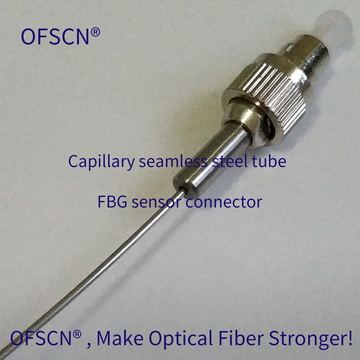
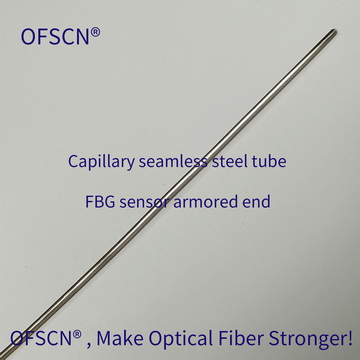
The OFSCN® 300°C Capillary Seamless Steel Tube Fiber Bragg Grating (FBG) temperature sensor developed by DCYS adopts a unique patented technology for stainless steel seamless tube packaging. Its structure is extremely simple, with no adhesive or Sonstiges auxiliary materials. It is composed of only fiber bragg gratings (FBGs) and stainless steel seamless tubes. Therefore, determining its operating range only requires analyzing the fiber bragg gratings (FBGs) and stainless steel materials.
 |
 |
|
Abbildung 1 |
Abbildung 2 |
For the OFSCN® 300°C Capillary Seamless Steel Tube Fiber Bragg Grating (FBG) temperature sensor, its low-temperature working temperature range at the measurement point is -200°C, its long-term working temperature range in the high-temperature region is up to +300°C, und its short-term working temperature range in the high-temperature region is up to +350°C. In actual measurements, the sensor has been used at temperatures up to +600°C for short durations.
Die Temperatur dieser beiden Hochtemperaturbereiche erreicht weder die Temperaturgrenze von Edelstahlmaterialien noch die Grenze des FBG-Beschichtungsmaterials Polyimid. Dieser Temperaturbereich wird hauptsächlich durch die Produktionsmethoden von FBG mittels UV-Belichtungsschablonen begrenzt.
2. Arbeitstemperaturbereich von FBG für OFSCN® 300-degree Celsius Capillary Seamless Steel Tube FBG Temperature Sensor (FBG Thermometer)
 |
|
Abbildung 3 |
 |
| Abbildung 4 |
Das mittels Ultraviolett (UV)-Schreibmasken-Produktionsverfahren hergestellte Faser-Bragg-Gitter (FBG) kann bei längerer Exposition in einer Temperaturumgebung von 400°C eine Degradation erfahren. Diese Degradation äußert sich beim FBG-Sensor als allmählicher Rückgang der Reflexionsrate des Faser-Bragg-Gitters während des Gebrauchs.
To ensure safety und reliability, DCYS has determined the working temperature range for the FBG sensor. The low-temperature region operates within -200°C, while the long-term working temperature range in the high-temperature region is up to +300°C. Additionally, the FBG sensor can withstand short-term use at temperatures up to +350°C, meaning it can be repeatedly used in environments up to +350°C (continuous use in a 300°C environment). It's important to note that the high-temperature range is based on actual measured values, while the low-temperature range is based on theoretical values.
 |
| Abbildung 5 |
Our philosophy is: 'OFSCN®, make optical fiber stronger!'
DCYS is a professional 300°C FBG temperature sensor manufacturer, providing 300°C FBG temperature sensor calibration method, calibration experiment, test report, temperature coefficient, calibration function and Sonstiges information; 300°C fiber bragg grating temperature sensor brand is 'OFSCN'.