
Enciclopedia de Tecnología de Sensores de Rejilla de Bragg de Fibra - Preguntas Frecuentes de FBG - Preguntas Frecuentes de Sensores FBG - Preguntas Frecuentes de Demoduladores FBG - Análisis de Problemas Comunes de Aplicación de FBG
Wavelength Range of Fiber Bragg Grating Sensors - Fiber Bragg Gratings with Encapsulated C-Band y Customizable Wavelengths
This article introduces the concept of wavelength customization for FBG sensors y under what circumstances the wavelength of the sensors can be customized. It answers the question of 'Can the wavelength of FBG sensors be customized?' y provides the wavelength customization range for OFSCN® Capillary Seamless Steel Tube FBG Sensors.
Cabe señalar que, ya sea un sensor de temperatura FBG (termómetro FBG), un sensor de deformación FBG (extensómetro FBG) o un sensor de estrés FBG (manómetro de estrés FBG), se puede personalizar la longitud de onda. Sin embargo, esto conlleva un precio más alto y un ciclo de producción más largo.
1. ¿Se Puede Especificar la Longitud de Onda de FBG?
Each OFSCN® Capillary Seamless Steel Tube FBG Sensor has a unique FBG wavelength during production. The wavelength can theoretically be any value between 1525nm and 1565nm, as well as values near the 850nm or 1310nm bands, or Otros values within the range of 400nm to 2200nm (typical example being 1064nm). However, there are certain limitations to defining the wavelength.
Las FBG escritas usando métodos de fotomáscara ultravioleta tienen sus longitudes de onda limitadas por la fotomáscara. Una vez que se determinan los parámetros de la fotomáscara, la FBG producida usando esa fotomáscara tendrá una longitud de onda predeterminada.
Por otro lado, las FBG escritas usando inscripción punto por punto con láser de femtosegundos pueden tener sus longitudes de onda ajustadas libremente.
El valor de la longitud de onda se puede usar para producir todo tipo de sensores FBG (sensores de temperatura, estrés, deformación FBG), y diferentes valores de longitud de onda no afectan los resultados de la medición (aunque pueden afectar los coeficientes de calibración).
 |
|
Figura 1 |
2. Los Sensores FBG Distribuidos Necesitan FBG con Múltiples Longitudes de Onda
The main reason for customizing specific wavelengths is often due to the wavelength limitations of the FBG demodulator or the network application requirements of the FBG sensors.
Además, en los sensores FBG distribuidos únicos (también conocidos como sensores FBG en serie o sensores FBG en array), diferentes FBG deben tener diferentes longitudes de onda y una separación suficiente entre ellos sin superposición. Si se colocan en diferentes canales del demodulador FBG, se puede usar la misma longitud de onda.
 |
|
Figura 2 |
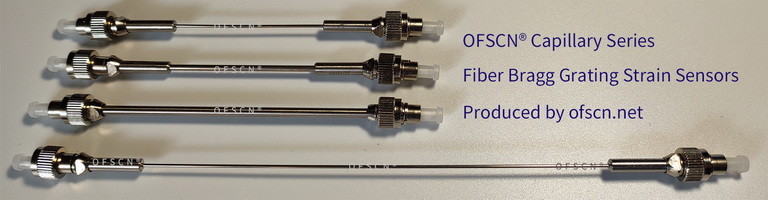
Double-ended OFSCN® Capillary Seamless Steel Tube FBG Sensors can also be used in series for the measurement of multiple physical quantities or mixed measurements (stress, strain, y temperature). In this case, each sensor needs to be customized with a different wavelength to distinguish different reflection wavelengths.
 |
|
Figura 3 |
OFSCN® Capillary Seamless Steel Tube FBG Sensors produced by DCYS typically have a standard wavelength range near the C-band (approximately between 1525nm and 1565nm). Otros wavelength products can be customized according to customer requirements.
Our philosophy is: 'OFSCN®, make optical fiber stronger!'
DCYS is a professional wavelength-customized Fiber Bragg Grating sensor manufacturer, providing customized wavelength FBG temperature sensors, C-band center wavelength FBG stress-strain sensors and Otros information; the brand of FBG sensors with customizable wavelengths is 'OFSCN'.