
Faser-Bragg-Gitter-Dehnungssensor - FBG-Dehnungsmessstreifen - Konzept Klassifizierung Prinzip Temperaturkompensation Anwendung Preis
Inhaltsverzeichnis:
Ⅰ. Relationship among OFSCN® Fiber Bragg Grating Strain Sensor, OFSCN® Faser-Bragg-Gitter-Wegsensor, OFSCN® Fiber Bragg Grating Stress Sensor and OFSCN® Fiber Bragg Grating Deformation Sensor
The OFSCN® Fiber Bragg Grating Strain Sensor is the most common and widely used sensor among OFSCN® Fiber Bragg Grating Sensors. It shares a direct correspondence with OFSCN® Faser-Bragg-Gitter-Wegsensor, OFSCN® Fiber Bragg Grating Stress Sensor and OFSCN® Fiber Bragg Grating Deformation Sensor, so they have the same structure.
1. Relationship between OFSCN® Fiber Bragg Grating Strain Sensor and OFSCN® Faser-Bragg-Gitter-Wegsensor
The OFSCN® Faser-Bragg-Gitter-Wegsensor is an application that extracts parameters from OFSCN® Fiber Bragg Grating Strain Sensor. The relationship is given by: Displacement = Total Length × Strain. Therefore, the structure of OFSCN® Faser-Bragg-Gitter-Wegsensor is the same as OFSCN® Fiber Bragg Grating Strain Sensor, with the difference lying in the calibration formula, which corresponds length to wavelength values.
2. Relationship between OFSCN® Fiber Bragg Grating Strain Sensor and OFSCN® Faser-Bragg-Gitter-Spannungssensor
The OFSCN® Faser-Bragg-Gitter-Spannungssensor is a calculating application of OFSCN® Fiber Bragg Grating Strain Sensor. The relationship is given by: Measured Stress = Elastic Modulus of the Measured Object × Strain. Therefore, the structure of OFSCN® Faser-Bragg-Gitter-Spannungssensor is the same as OFSCN® Fiber Bragg Grating Strain Sensor. However, as the tested materials differ after purchasing the OFSCN® Faser-Bragg-Gitter-Spannungssensor, the calibration formula corresponds micro-strain to wavelength values.
3. Relationship between OFSCN® Faser-Bragg-Gitter Strain Sensor and OFSCN® Faser-Bragg-Gitter Deformation Sensor
'OFSCN® Fiber Bragg Grating Deformation Sensor' is not a precise term. Deformation can be expressed as displacement - in this case, corresponding to OFSCN® Faser-Bragg-Gitter-Wegsensor, or it can be expressed as strain - in this case, corresponding to OFSCN® Fiber Bragg Grating Strain Sensor.
Ⅱ. What is an OFSCN® Faser-Bragg-Gitter Strain Sensor? Basic Concept of FBG Strain Gauge
The OFSCN® Faser-Bragg-Gitter Ein Dehnungssensor ist ein Sensortyp, der ein Faser-Bragg-Gitter (FBG) als sensibles Element verwendet. Er wird kombiniert mit einem FBG-Demodulator (FBG-Analysator, FBG-Interrogator) und am Messobjekt zur Dehnungsmessung, -erfassung und -überwachung befestigt.
The OFSCN® Faser-Bragg-Gitter Strain Sensor is also known as an FBG Strain Gauge. It belongs to the category of Faser-Bragg-Gitter Sensors and is a type of fiber sensor. In terms of function, it is classified as a strain sensor.
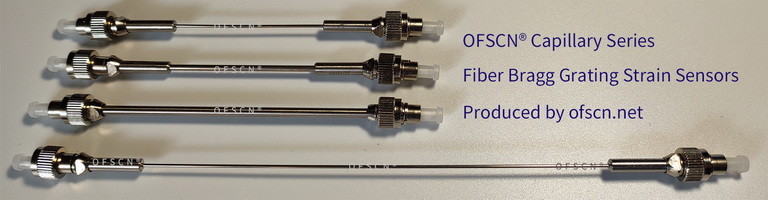
Ⅲ. Classification of OFSCN® Faser-Bragg-Gitter Strain Sensors
OFSCN® Faser-Bragg-Gitter Strain Sensors can be classified based on the different encapsulation materials, which result in different measurement ranges.
Currently, there are three types: Regular OFSCN® Faser-Bragg-Gitter Strain Sensors - metal encapsulation with a maximum measurement range of 2000 με (microstrain), Large Measurement Range OFSCN® Faser-Bragg-Gitter Strain Sensors - polymer material encapsulation with a maximum measurement range of 10,000 με (microstrain), and Ultra-Large Measurement Range OFSCN® Faser-Bragg-Gitter Strain Sensors - a hybrid encapsulation of polymer material and elastomer, with a minimum measurement range greater than 10,000 με (deformation rate of 1%) and typical measurement ranges of 100,000 με (microstrain) for a 10% deformation rate and 300,000 με (microstrain) for a 30% deformation rate.
OFSCN® Faser-Bragg-Gitter Strain Sensors can also be classified based on the number of FBG strain measurement points, such as single-point and multi-point sensors.
Sie können auch nach verschiedenen Kapselungsmaterialien, Strukturen und Einsatzprozessen kategorisiert werden, einschließlich rohrförmiger, waferförmiger (oberflächenmontierter) und Oberflächen-FBG-Dehnungssensoren.
There are many other classification methods for OFSCN® Faser-Bragg-Gitter Strain Sensors, and DCYS can provide customized sensors of different types, which will not be further elaborated here...

Ⅳ. Principle of Strain Measurement for OFSCN® Faser-Bragg-Gitter Strain Sensor
OFSCN® Faser-Bragg-Gitter Strain Sensor can be used for strain and deformation measurements based on the following principle:
Grundprinzipien von Faser-Bragg-Gittern und Faser-Bragg-Gitter-Sensoren - Teil 2: FBG-Messprinzipien
Ⅴ. Temperature Compensation Principle for OFSCN® Faser-Bragg-Gitter Strain Sensor
When used for strain and deformation measurements, OFSCN® Faser-Bragg-Gitter Strain Sensor needs to compensate for temperature effects. This process is known as temperature compensation for OFSCN® Faser-Bragg-Gitter Strain Sensor, and its principle is as follows:
Prinzip und Schema der Temperaturkompensation für Faser-Bragg-Gitter (FBG) Dehnungssensoren
Ⅵ. Application of OFSCN® Faser-Bragg-Gitter Strain Sensor - Civil Engineering Applications
OFSCN® Faser-Bragg-Gitter Strain Sensor is the most widely used among all optical fiber sensors. It can be widely applied in various environments for strain measurements, including civil engineering, bridges, tunnels, buildings, large mechanical components, slope applications, excavation projects, and other fields for strain and deformation measurements, monitoring, and testing. It also serves as the foundation for producing other types of FBG sensors. Its applications are exceptionally diverse, and further details are not elaborated here by DCYS.
Ⅶ. Structure of OFSCN® Faser-Bragg-Gitter Strain Sensor
DCYS produces the OFSCN® capillary series FBG strain sensors, which can be customized with various structures. The standard structures are as follows:
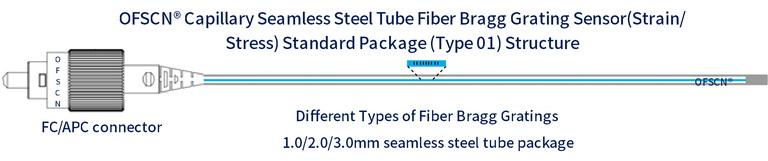 |
| Structure diagram of OFSCN® Capillary seamless steel tube Faser-Bragg-Gitter strain sensor (single-ended ) |
 |
| Structure diagram of OFSCN® Tubular large-range Faser-Bragg-Gitter strain sensor (double-ended, can be connected in series) |
Ⅷ. Measuring Range of OFSCN® Faser-Bragg-Gitter Strain Sensor
OFSCN® capillary series Faser-Bragg-Gitter strain sensors produced by DCYS, have the following measuring ranges:
3、Weitbereichs-Faser-Bragg-Gitter-Dehnungssensor - Bragg FBG Dehnungsmessstreifen - Metallschutz, Messbereich: 30000με (anpassbar bis zu einem Maximum von 50000με)
Ⅸ. Model and Parameters of OFSCN Faser-Bragg-Gitter Strain Sensor
OFSCN® capillary series Faser-Bragg-Gitter strain sensors, which use DCYS's proprietary 'stainless steel seamless tube encapsulation technology' and 'high molecular material encapsulation technology' for FBG encapsulation, come in various models.
Die Produktstruktur ist einfach und kann entweder einseitig sein, einen Einzelpunkt verkapselnd FBG zum Einsetzen in das Messobjekt zur Dehnungsmessung, oder beidseitig zur Immersion oder Oberflächenmontage zur Dehnungsmessung, wodurch eine Mehrpunkt-Quasi-Verteilte Dehnungsmessung in Serie erreicht wird.
The specific model numbers and parameters of OFSCN® capillary series Faser-Bragg-Gitter strain sensors designed by DCYS can be found in the related product introduction.
Ⅹ. Installation and Placement of OFSCN® Faser-Bragg-Gitter Strain Sensor
OFSCN® capillary® series Faser-Bragg-Gitter strain sensors, produced by DCYS, have the advantages of simple installation and flexible placement. They can be installed in two main ways:
1. Kundenspezifische Vorrichtungen zum Bohren und Befestigen oder Schweißen für Installation und Platzierung.
2. Kundenspezifische Basismaterialien für die Klebeplatzierung.
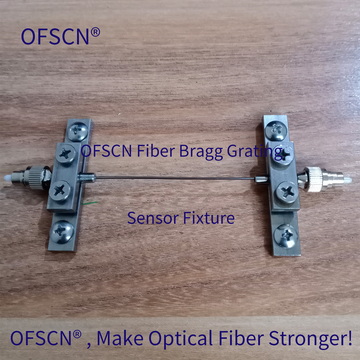
Ⅺ. Oberflächen-Faser-Bragg-Gitter-Dehnungssensor - Gekrümmter Oberflächen-Faser-Bragg-Gitter-Dehnungssensor
DCYS can customize special bases and fixtures for Faser-Bragg-Gitter strain sensors according to customers' usage requirements and the actual working environment of the sensors, enabling the installation and fixation of Faser-Bragg-Gitter strain sensors on the surface of the measured object.
At this point, the OFSCN® Faser-Bragg-Gitter strain sensor becomes a surface FBG strain sensor or surface-mounted FBG strain sensor. It can also be adhered and placed on various curved surfaces, turning it into a curved surface FBG strain sensor. If arranged on the surface of a pipeline, it can be referred to as a FBG pipeline strain sensor.
Ⅻ. Wichtige Punkte für den Kauf eines Faser-Bragg-Gitter-Dehnungssensors
DCYS produces a rich variety and numerous models of the OFSCN® series Faser-Bragg-Gitter strain sensors. When making a purchase, you should consider your specific needs:
1. Bestimmen Sie klar den Messbereich der Dehnung, die Sie testen müssen. Die Bestätigung des maximal erforderlichen Messbereichs hilft Ihnen bei der Entscheidung über die Struktur des FBG-Dehnungssensors, den Sie verwenden werden.
2. Bestimmen Sie klar die Anzahl der erforderlichen Dehnungsmesspunkte. Entscheiden Sie, ob Sie eine Einzelpunkt- oder Mehrpunkt-Dehnungsmessung benötigen, und wenn es sich um Mehrpunkt handelt, müssen Sie die Anzahl der für einen Sensor benötigten FBG bestätigen.
3. Consider the length of the object to be measured. The length of OFSCN® large-range Faser-Bragg-Gitter strain sensors can be customized, ranging from a few centimeters to tens of meters.
4. Decide the placement method of the sensor. Confirming the placement method of the Faser-Bragg-Gitter strain sensor will determine if you need corresponding customized sensor fixtures. DCYS has rich experience in customizing Faser-Bragg-Gitter strain sensors for various applications.
XIII. Preisgestaltung für Faser-Bragg-Gitter-Dehnungssensoren
After providing DCYS with the required information such as the measuring range, number of measurement points, length, and placement method of the Faser-Bragg-Gitter strain sensor, DCYS will calculate the price for you.