
Encyclopédie de la technologie de détection par réseaux de Bragg sur fibre - FAQ FBG - FAQ capteurs FBG - FAQ démodulateurs FBG - Analyse des problèmes d'application courants FBG
Sensibilité des capteurs de température à réseau de Bragg sur fibre - Vitesse de conduction thermique du thermomètre FBG - Vitesse de changement de température
This article discusses the sensitivity of FBG temperature sensors from the perspective of thermal conductivity (temperature change conduction speed). In Autres words, it refers to the ability of FBG temperature sensors to detect accurate temperature changes in the shortest possible time (their response capability to rapidly changing temperatures). It also highlights the high sensitivity and fast thermal conduction of the encapsulation materials and structure used in the OFSCN® capillary seamless steel tube series FBG temperature sensors.
1. Concept de sensibilité à la conductivité thermique dans les capteurs de température à réseaux de Bragg sur fibre
Une autre façon d'analyser la sensibilité des capteurs de température FBG est de considérer leur vitesse de réponse aux changements de température (par rapport à un autre article :'Sensibilité des capteurs de température FBG - Perspective de résolution').
Dans ce contexte, la sensibilité des capteurs de température FBG fait référence au temps nécessaire au capteur pour refléter les changements de température lorsque l'objet ou l'environnement mesuré subit des variations de température.
Un capteur très sensible est capable de détecter plus rapidement les variations de température. À cet égard, l'efficacité de la conductivité thermique et la distance jouent un rôle crucial, influencées par le matériau et la structure du capteur à réseau de fibre optique.
2. Reasons for High Thermal Conductivity Sensitivity of OFSCN® Capillary Seamless Steel Tube FBG Temperature Sensors
OFSCN® capillary seamless steel tube FBG temperature sensors ( FBG thermometer, FBG temperature probe ), provided by DCYS, have high sensitivity. The secret of it lies in the material et structure of the sensors.
 |
 |
|
Figure 1 |
Figure 2 |
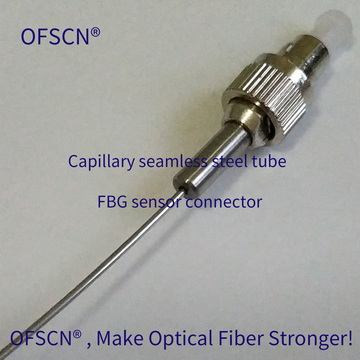
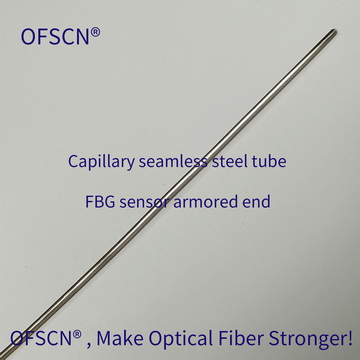
As shown in Figure 1, 2, et 3, OFSCN® capillary seamless steel tube FBG temperature sensors adopt a unique patented technology of stainless steel seamless tube encapsulation. With a minimalist-style design et absence of adhesives or auxiliary materials, these sensors exhibit exceptional sensitivity et quickly respond to temperature changes in the tested environment.
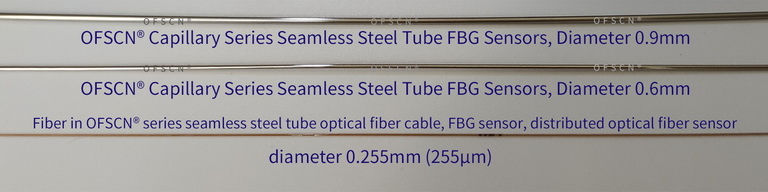
The stainless steel material used in OFSCN® capillary seamless steel tube FBG temperature sensors has a thermal conductivity rate of 0.16/(W/m℃)×10², which is relatively high compared to Autres commonly used materials. Additionally, the small size of the sensor, with a diameter ranging from 0.9mm to 0.6mm, results in a short thermal conductivity distance. Consequently, the entire sensor demonstrates high sensitivity, promptly reflecting temperature fluctuations in the tested objects and environment.
 |
|
Figure 3 |
In addition, because the volume of OFSCN® capillary seamless steel tube FBG temperature sensor (FBG thermometer, FBG temperature probe) is small, the main structure diameter is generally only 0.9 mm, et the minimum diameter is 0.6 mm ( see Figure 4 below ). Therefore, the thermal conductivity distance is very short. Reflected in the demodulation equipment, it shows that the sensitivity of the entire sensor is very high, which can quickly reflect the rapid temperature change of measured object et environmental.
 |
|
Figure 4 |
3. Enhancing or Reducing the Thermal Conductivity Sensitivity of OFSCN® Capillary Seamless Steel Tube FBG Temperature Sensors
Of course, when we use the OFSCN® capillary seamless steel tube FBG temperature sensor (FBG thermometer, FBG temperature probe ) for temperature testing, it is not all the faster the sensor thermal conduction speed requires the better.
The thermal conductivity speed of OFSCN® capillary seamless steel tube FBG temperature sensors can be customized by altering the structure based on the stainless steel seamless tube encapsulation technology provided by DCYS. These modifications enable the adjustment of the sensor's thermal conductivity sensitivity according to specific requirements. For example:
 |
 |
 |
 |
 |
…… |
Remarque : Les illustrations des produits ci-dessus, la taille est dessinée selon la proportion réelle, bien que l'épaisseur puisse varier.
9 septembre 2019, Remarque :
After discussing with industry experts, it has been confirmed that FBG sensors can detect temperature changes at a rate of at least 1000Hz, meaning they can reflect temperature variations over 1000 times per second. Due to the advantages brought by the unique structure et patented design of OFSCN® capillary seamless steel tube FBG temperature sensors, I have great confidence in their thermal conductivity sensitivity. However, due to limitations in testing methods et environments, specific numerical values cannot be provided at this time.
Our philosophy is: 'OFSCN®, make optical fiber stronger!'
DCYS is a professional manufacturer of high-sensitivity fiber bragg grating temperature sensors, providing information on FBG temperature sensor sensitivity, heat conduction speed, temperature change response speed, Avantages des capteurs FBG, etc. The brand of high-sensitivity FBG sensors is 'OFSCN' .