
Sensor de Deformación de Red de Bragg de Fibra - Galga Extensométrica FBG - Concepto Clasificación Principio Compensación de Temperatura Aplicación Precio
Tabla de Contenidos:
Ⅰ. Relationship among OFSCN® Fiber Bragg Grating Strain Sensor, OFSCN® Sensor de Desplazamiento de Red de Bragg de Fibra, OFSCN® Fiber Bragg Grating Stress Sensor and OFSCN® Fiber Bragg Grating Deformation Sensor
The OFSCN® Fiber Bragg Grating Strain Sensor is the most common and widely used sensor among OFSCN® Fiber Bragg Grating Sensors. It shares a direct correspondence with OFSCN® Sensor de Desplazamiento de Red de Bragg de Fibra, OFSCN® Fiber Bragg Grating Stress Sensor and OFSCN® Fiber Bragg Grating Deformation Sensor, so they have the same structure.
1. Relationship between OFSCN® Fiber Bragg Grating Strain Sensor and OFSCN® Sensor de Desplazamiento de Red de Bragg de Fibra
The OFSCN® Sensor de Desplazamiento de Red de Bragg de Fibra is an application that extracts parameters from OFSCN® Fiber Bragg Grating Strain Sensor. The relationship is given by: Displacement = Total Length × Strain. Therefore, the structure of OFSCN® Sensor de Desplazamiento de Red de Bragg de Fibra is the same as OFSCN® Fiber Bragg Grating Strain Sensor, with the difference lying in the calibration formula, which corresponds length to wavelength values.
2. Relationship between OFSCN® Fiber Bragg Grating Strain Sensor and OFSCN® Sensor de Tensión de Red de Bragg de Fibra
The OFSCN® Sensor de Tensión de Red de Bragg de Fibra is a calculating application of OFSCN® Fiber Bragg Grating Strain Sensor. The relationship is given by: Measured Stress = Elastic Modulus of the Measured Object × Strain. Therefore, the structure of OFSCN® Sensor de Tensión de Red de Bragg de Fibra is the same as OFSCN® Fiber Bragg Grating Strain Sensor. However, as the tested materials differ after purchasing the OFSCN® Sensor de Tensión de Red de Bragg de Fibra, the calibration formula corresponds micro-strain to wavelength values.
3. Relationship between OFSCN® Red de Bragg de Fibra Strain Sensor and OFSCN® Red de Bragg de Fibra Deformation Sensor
'OFSCN® Fiber Bragg Grating Deformation Sensor' is not a precise term. Deformation can be expressed as displacement - in this case, corresponding to OFSCN® Sensor de Desplazamiento de Red de Bragg de Fibra, or it can be expressed as strain - in this case, corresponding to OFSCN® Fiber Bragg Grating Strain Sensor.
Ⅱ. What is an OFSCN® Red de Bragg de Fibra Strain Sensor? Basic Concept of FBG Strain Gauge
The OFSCN® Red de Bragg de Fibra El sensor de deformación es un tipo de sensor que utiliza una Red de Bragg de Fibra (FBG) como elemento sensible. Se combina con un demodulador FBG (analizador FBG, interrogador FBG) y se fija al objeto medido para la medición, detección y monitorización de la deformación.
The OFSCN® Red de Bragg de Fibra Strain Sensor is also known as an FBG Strain Gauge. It belongs to the category of Red de Bragg de Fibra Sensors and is a type of fiber sensor. In terms of function, it is classified as a strain sensor.
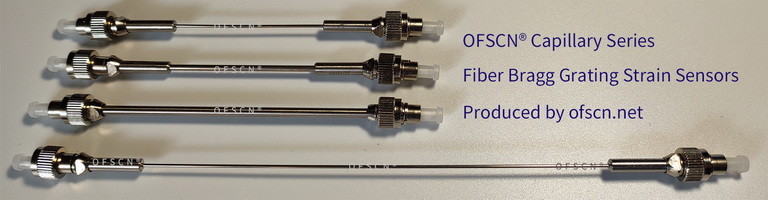
Ⅲ. Classification of OFSCN® Red de Bragg de Fibra Strain Sensors
OFSCN® Red de Bragg de Fibra Strain Sensors can be classified based on the different encapsulation materials, which result in different measurement ranges.
Currently, there are three types: Regular OFSCN® Red de Bragg de Fibra Strain Sensors - metal encapsulation with a maximum measurement range of 2000 με (microstrain), Large Measurement Range OFSCN® Red de Bragg de Fibra Strain Sensors - polymer material encapsulation with a maximum measurement range of 10,000 με (microstrain), and Ultra-Large Measurement Range OFSCN® Red de Bragg de Fibra Strain Sensors - a hybrid encapsulation of polymer material and elastomer, with a minimum measurement range greater than 10,000 με (deformation rate of 1%) and typical measurement ranges of 100,000 με (microstrain) for a 10% deformation rate and 300,000 με (microstrain) for a 30% deformation rate.
OFSCN® Red de Bragg de Fibra Strain Sensors can also be classified based on the number of FBG strain measurement points, such as single-point and multi-point sensors.
También se pueden clasificar según diferentes materiales de encapsulación, estructuras y procesos de despliegue, incluyendo sensores de deformación FBG tipo tubo, tipo oblea (montaje en superficie) y de superficie.
There are many other classification methods for OFSCN® Red de Bragg de Fibra Strain Sensors, and DCYS can provide customized sensors of different types, which will not be further elaborated here...

Ⅳ. Principle of Strain Measurement for OFSCN® Red de Bragg de Fibra Strain Sensor
OFSCN® Red de Bragg de Fibra Strain Sensor can be used for strain and deformation measurements based on the following principle:
Ⅴ. Temperature Compensation Principle for OFSCN® Red de Bragg de Fibra Strain Sensor
When used for strain and deformation measurements, OFSCN® Red de Bragg de Fibra Strain Sensor needs to compensate for temperature effects. This process is known as temperature compensation for OFSCN® Red de Bragg de Fibra Strain Sensor, and its principle is as follows:
Ⅵ. Application of OFSCN® Red de Bragg de Fibra Strain Sensor - Civil Engineering Applications
OFSCN® Red de Bragg de Fibra Strain Sensor is the most widely used among all optical fiber sensors. It can be widely applied in various environments for strain measurements, including civil engineering, bridges, tunnels, buildings, large mechanical components, slope applications, excavation projects, and other fields for strain and deformation measurements, monitoring, and testing. It also serves as the foundation for producing other types of FBG sensors. Its applications are exceptionally diverse, and further details are not elaborated here by DCYS.
Ⅶ. Structure of OFSCN® Red de Bragg de Fibra Strain Sensor
DCYS produces the OFSCN® capillary series FBG strain sensors, which can be customized with various structures. The standard structures are as follows:
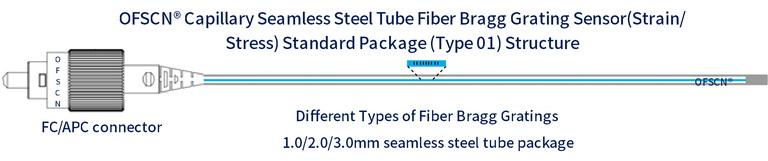 |
| Structure diagram of OFSCN® Capillary seamless steel tube Red de Bragg de Fibra strain sensor (single-ended ) |
 |
| Structure diagram of OFSCN® Tubular large-range Red de Bragg de Fibra strain sensor (double-ended, can be connected in series) |
Ⅷ. Measuring Range of OFSCN® Red de Bragg de Fibra Strain Sensor
OFSCN® capillary series Red de Bragg de Fibra strain sensors produced by DCYS, have the following measuring ranges:
3、Sensor de Deformación de Red de Bragg de Fibra de Gran Rango - Galga Extensométrica FBG de Bragg - Protección metálica, rango de medición: 30000με (personalizable hasta un máximo de 50000με)
Ⅸ. Model and Parameters of OFSCN Red de Bragg de Fibra Strain Sensor
OFSCN® capillary series Red de Bragg de Fibra strain sensors, which use DCYS's proprietary 'stainless steel seamless tube encapsulation technology' and 'high molecular material encapsulation technology' for FBG encapsulation, come in various models.
La estructura del producto es simple y puede ser de un solo extremo, encapsulando un solo punto FBG para inserción en el objeto medido para la medición de deformación, o de doble extremo para inmersión o montaje en superficie para la medición de deformación, logrando una medición de deformación cuasi-distribuida multipunto en serie.
The specific model numbers and parameters of OFSCN® capillary series Red de Bragg de Fibra strain sensors designed by DCYS can be found in the related product introduction.
Ⅹ. Installation and Placement of OFSCN® Red de Bragg de Fibra Strain Sensor
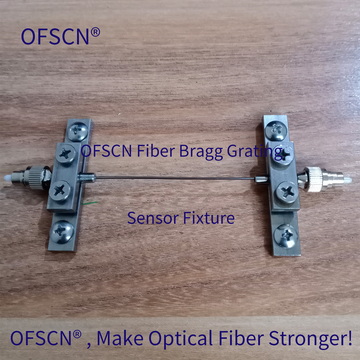
OFSCN® capillary® series Red de Bragg de Fibra strain sensors, produced by DCYS, have the advantages of simple installation and flexible placement. They can be installed in two main ways:
1. Fijaciones personalizadas para taladrar y fijar o soldar para la instalación y colocación.
2. Materiales base personalizados para la colocación con adhesivo.
Ⅺ. Sensor de Deformación de Red de Bragg de Fibra de Superficie - Sensor de Deformación de Red de Bragg de Fibra de Superficie Curva
DCYS can customize special bases and fixtures for Red de Bragg de Fibra strain sensors according to customers' usage requirements and the actual working environment of the sensors, enabling the installation and fixation of Red de Bragg de Fibra strain sensors on the surface of the measured object.
At this point, the OFSCN® Red de Bragg de Fibra strain sensor becomes a surface FBG strain sensor or surface-mounted FBG strain sensor. It can also be adhered and placed on various curved surfaces, turning it into a curved surface FBG strain sensor. If arranged on the surface of a pipeline, it can be referred to as a FBG pipeline strain sensor.
Ⅻ. Puntos Clave para la Compra de un Sensor de Deformación de Red de Bragg de Fibra
DCYS produces a rich variety and numerous models of the OFSCN® series Red de Bragg de Fibra strain sensors. When making a purchase, you should consider your specific needs:
1. Determine claramente el rango de medición de la deformación que necesita probar. Confirmar el rango máximo de medición requerido le ayudará a decidir la estructura del sensor de deformación FBG que utilizará.
2. Determine claramente el número de puntos de medición de deformación requeridos. Decida si necesita una medición de deformación de un solo punto o multipunto, y si es multipunto, debe confirmar el número de FBG requeridos para un sensor.
3. Consider the length of the object to be measured. The length of OFSCN® large-range Red de Bragg de Fibra strain sensors can be customized, ranging from a few centimeters to tens of meters.
4. Decide the placement method of the sensor. Confirming the placement method of the Red de Bragg de Fibra strain sensor will determine if you need corresponding customized sensor fixtures. DCYS has rich experience in customizing Red de Bragg de Fibra strain sensors for various applications.
XIII. Precios del Sensor de Deformación de Red de Bragg de Fibra
After providing DCYS with the required information such as the measuring range, number of measurement points, length, and placement method of the Red de Bragg de Fibra strain sensor, DCYS will calculate the price for you.